


Yay! My xInvoice module is ready and can be installed! Here you will find the operating instructions. And, as always with my solutions:
- No monthly or annual fees
- No additional programs need to be installed
- 100% Navision / BC365 integrated
- Can be expanded as desired, even by you (I always provide all source code)
No time for a lot of background information? Jump straight to the last point “Recommended action”
The information provided here applies to all companies based in Germany, regardless of whether you use Navision Financials, Dynamics, Attain, or Microsoft Business Central BC365—or any other ERP/financial accounting software,whether on an AS400, cloud solutionscombined ERP/financial accounting programs, Datev. The original version of this article dates from October 2023. At that time, I cautiously predicted that this solution, typically German, would certainly not make things easier, but would instead become a new, ill-conceived administrative juggernaut for even better monitoring of the few remaining honest taxpayers... because fraudsters would continue to find ways around this system. And that is exactly how it has turned out now, in March 2024. Nevertheless, unless you emigrate to a third country, you will no longer be able to avoid e-billing. Tip: See it as an opportunity to thoroughly clean up your entire billing process from the dust and mustiness of the last millennium, with its filing folders and all.
In this updated article, I have deleted or shortened parts of the old assumptions, as they have been overtaken by reality, and incorporated new information.
Estimated reading time: 23 minutes
Sources
Various sources, but these are worth linking to directly:
https://www.heise.de/hintergrund/Pflicht-zur-E-Rechnung-im-XML-Format-Das-ist-der-Status-quo-9593920.html by authors (Jochen Stärk, Andreas Pelekies) of the technical specifications. Incidentally, they are aware of the shortcomings that I pointed out here last year. They themselves note in their apology that these specifications were only intended for exchange between authorities from the outset. That doesn't make it any better...
https://www.heise.de/news/Bundesrat-stimmt-zu-E-Rechnungspflicht-fuer-Firmen-kommt-ab-2025-9663131.html Growth Opportunities Act... Who actually comes up with such euphemisms for even more bureaucracy, even higher (initial) costs, and even more (initial) administrative work for businesses?
https://www.heise.de/hintergrund/E-Rechnungspflicht-Wie-Sie-strukturierte-elektronische-Rechnungen-erstellen-9625935.html Here, too, the focus is more on the shortcomings of the legal definitions, some of the tools are no longer available, and one thing you definitely won't find (as with most internet sources) in an article entitled “E-invoicing requirement: How to create structured electronic invoices” is instructions on how to create structured electronic invoices. That would be too easy.
History of ZUGFeRD (xRechnung, eRechnung)
Mandatory for invoicing public services (authorities) since 2020... but still (or perhaps because of this?) a lame horse in 2024. In fact, retailers have preferred to refrain from deliveries (and associated invoices) to authorities. This has naturally had consequences for German authorities, who have simply lost their suppliers.
To counteract this, from the beginning of the obligation, i.e. since 2020, there has been an exemption rule that invoices up to €250 no need have to be submitted as ZUGFeRD invoices. This was then even used to simply split larger invoices into smaller ones. This was recognized as additional work, so in 2021, for example, this minimum amount was increased to €1,000.
In practice, however, many authorities continued to simply accept PDF invoices received by email (yes, German authorities and email... without a fax!) without checking for the mandatory structured data. But this wasn't a problem in many offices: the PDF/A file was printed out anyway and forwarded to the paying agency in paper form. You can hear the bureaucracy neighing...
Limitations of ZUGFeRD
There were many criticisms of ZUGFeRD, e.g. the restriction of commercial freedom for business partners: ZUGFeRD PDF/a with embedded XML invoices could only be created electronically (hence e-invoice = electronic invoice). However, local authorities in particular still have a lot to do with paper invoices today because, for example, a farmer who clears a few roads and sidewalks for a municipality in winter will not buy a computer and certainly not special software for the few euros (which, however, can easily exceed 250/1,000 euros). Even after 2020, it was still common practice in municipalities as public authorities – and rightly so! – to accept any “invoice scribbled on a piece of bread” if they did not want to become completely incapacitated. You have to be pretty stupid to want to pick a fight with local farmers over trivialities, for example. But apparently, this has also been a good basis for government membership for decades.

But even for “real” suppliers, ZUGFeERD was no joy. For “real” businesses, electronic/automatic document recognition has been establishedfor years/decades... or, for adults, the solution: EDIfact. The last thing industry and commerce needed was yet another half-finished standard interface that was dying during its introduction... Do you know what's great about standards? That's right: there are so many of them...
And that is exactly what has happened: ZUGFeRD never made it into the free industry, and even before the little horse could pick up speed, it starved to death by the wayside. But it was more of a pony than a noble Andalusian.
Alternatives to ZUGFeRD?
But Germany wouldn't be Germany if they just said, “Oh well, we messed up.” We'll just accept PDFs via email now, like hundreds of thousands of companies around the world do. Or: Wait a minute, there was a small niche solution that's supposed to have been working for decades, even for big names like Siemens, Bayer, and Volkswagen... what was it called... I read something about it in the Bild newspaper recently... Ah, yes! EDI. Electronic Data Interchange. EDIfact. Used all over the world for decades, even without the ballast of X400/BTX. Once you get it up and running, it's stable and secure to use. Not cheap, but if you do it right, it's still cheaper than paper invoices in the end. EDIfact connects continents, and connects Navision with SAP, BC365 with KHK, Dynamics with Oracle...
To be fair, it must be said that EDI and EDIFact are indeed a punishment—expensive, complicated, and time-consuming to set up. Although there are service providers that simplify this process, EDI has always remained the preserve of the big players (SAP) and those who have been forced to play along (Navision and Business Central 365 Mittelstand).
Just as useless/unimaginable for the farmer clearing snow (see above).
And PDF? Yes... These can now also be created directly from Excel or Word and simply sent by email. This saves on paper, postage, shipping time, and manual labor. However, electronic document recognition does not come cheap (although GetMyInvoices is not really expensive...). But it is already more automation than fax machines in government offices 🙂 .
In this respect, the idea of introducing a simple standard to the market that is inexpensive to integrate (unlike EDI and electronic document recognition) and still offers high automation potential (unlike fax and paper) is actually not a bad idea. But why does it have to be as complicated as ZUGFeRD, with embedded XML in a PDF/A envelope? Word and the now standard PDF printer driver Microsoft print to PDF already fail with PDF/A..
xInvoice
And, listen up and be amazed: this has been recognized by federal authorities! And the solution isn't so bad after all: with xRechnung, now more commonly referred to as eRechnung, ZUGFeRD has been streamlined by removing the most complicated part—the PDF part. This is now simply omitted. What remains is a pure XML file, which can be written and read quite easily by many ERP/financial accounting systems without any hassle – including, of course, Navision Financials, Dynamics, Attain, and Microsoft Business Central BC365.
xInvoice / eInvoice transfer
But then those responsible became uneasy again: a simple solution, and from Germany? In the sense of “reducing bureaucracy”... Perhaps Germany is the only country where reducing bureaucracy is to be regulated by law... instead of simply abolishing nonsensical or irrational laws and administrative regulations? Well... simply XML is too simple after all. That's why the “Council of Experts” at least complicated the transfer process. The sender knows the recipient, and the recipient knows the sender. So why should the sender simply email the XML to the recipient?

So you build in intermediate instances, namely the Peppol network. Sound familiar? Yep! Business Mail X400, the old BTX standard, mandatory for EDI for many years. Until even EDI users, who were used to suffering, found it too stupid and switched to FTP or email decades ago. PEPPOL is not technically X400 or BTX, but it is just as unnecessary.
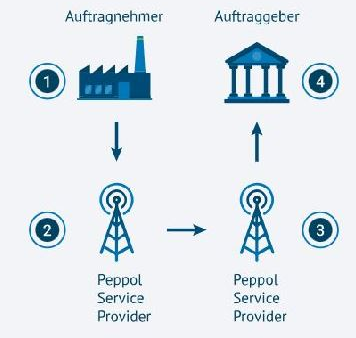
Unnecessary and costly? Yay! At least this way, we can make simple XML a little more complicated again! We'll take that! And to make matters even worse, it won't be comprehensive. By the end of 2023, approximately 80% of federal agencies and virtually no members of the private sector will be accessible via Peppol. According to Murphy's Law, the very agency you want to send an invoice to will definitely be inaccessible... What's more, you'll need an external service provider again or your own Peppol infrastructure, which comes at a cost(!). Well, who would have thought that those responsible for the German federal government couldn't learn from the private sector... Just take the worst and most stupid aspects of EDI (X400), which they have long since discarded.
Future
Well... predictions are difficult, especially when they concern the future.
ZUGFeRD has practically become a dead horse. The future, if it is to be written by German authorities (God forbid...), will lie in xInvoice The German procurement portal, for example, only invites suppliers to submit an xRechnung;; ZUGFeRD is no longer even prominently available for consideration.
I also think that email will become more standard as a submission option than Peppol. Important update 2024: A year ago, I predicted that xRechnung and its siblings, Cross Industry Invoice (CII) and Universal Business Language (UBL), would merely be the door openers for real-time sales reporting to the tax authorities. Since saving money is totally uncool, the EU member states are hoping to get a few million euros more and/or a few days earlier. To achieve this, companies in the EU will have to invest a few billion more. PREPPOL is currently being expanded to be able to process these real-time sales reports by around 2029. During the transition period, and especially until everyone has the technical capabilities to use PREPPOL, it will be easiest for Navision and BC365 users to temporarily (!) rely on email. Peppol will probably become mandatory by 2029 for xRechnung/eRechnungen, which will have been introduced nationwide by then.
The obligationto implement a new standard (and thus the first IT requirement in Germany!) was put to a vote at the end of ’23 . This draft already includes a postponement/delay of two years. Funnily enough, this draft stipulates that the ability to receive electronic invoices (the xRechnung format is already mentioned by name here) will become mandatory from January 1, 2025. That doesn't hurt anyone. However, the question of how this will be implemented has not even begun to be defined. Can companies be forced to participate in fee-based networks such as Peppol? What about foreigners? Chinese, Indians... they will continue to send their Excel invoices by email or fax. And then what?
Update March 2024: After xRechnung/e-Rechnung finally dropped its mask as the “Industry-Friendly Growth Opportunities Act” in March 2024, this was immediately defined: The primary goal is to record sales in the European Union in real time. Foreign business transactions are irrelevant in this context and can therefore continue to be submitted as fax, Word, or Excel invoices from China.
According to the current draft, companies with an annual turnover of €800,000 or more will be required to issue electronic invoices from January 1, 2026. OK, OK, OK... Inflation will play its part in pushing more small businesses over this threshold, but... seriously: The “big players” have already been using EDIfact for two generations... which is even mentioned by name in the draft. However, interpretations state that EDI does not comply with European requirements and will therefore not satisfy this legal situation in the future... I am very curious to hear what Volkswagen, BMW, Siemens, Mercedes, and Airbus will say about this amusing idea.
Don't forget: large companies, especially SAP users, have even managed to get a change in copyright law and copyright remuneration, so that foreign programming services (India, etc.) are no longer subject to social security contributions for artists (“withholding tax obligation”) ... Have you ever heard of this obligation? No? It doesn't matter now, it's off the table. You will probably also have EDI and IDoc included in the “permitted” formats.
From January 1, 2027, every business (with annual sales of €800,000 or more) in Germany will be required to issue electronic invoices. Which is somehow in keeping with the times. And from January 1, 2028, this will apply to everyone. Even corner shops... Unless they only have end customers, because this requirement does not apply to those sales (of course).
However, it should not be forgotten that this is not really a law aimed at streamlining business operations! That would be easier: simply scrap a few thousand administrative guidelines and reporting requirements, and hey presto! Hundreds of thousands of companies would save time and money. This is a new tax monitoring regulation, specifically aimed at preventing input tax fraud. It is therefore a monitoring option that companies themselves must introduce and pay for. The background to all this magic is ViDA (or VAT in the Digital Age), which already reveals a lot about the true intentions of the legislator. I find the irony in phrases such as “fair taxation” ... But let's leave that aside, it quickly becomes too polemical. EDIfact will remain, especially since it can be converted automatically to e-invoice/x-invoice (e.g., in ZUGPFeRD, x-invoice (Factur-X), Cross Industry Invoice (CII), or Universal Business Language (UBL) format) sufficiently well for ViDA.
My recommendation for action is also based on this premise:
So why create such a huge bureaucratic monster again, costing taxpayers (authorities) and the free economy billions of euros? Precisely because of this sales tax fraud (“sales tax carousel”). Why not simply not refund any taxes at all? Input tax credits are carried forward as credits, because at some point every company wants to generate sales, otherwise there is something wrong with the business model. The same applies to share deals, and cum-ex would never have occurred. Too simple? Yep, too simple. Better to hold millions (across Europe!) of companies generally liable and place them under initial suspicion than to pursue pragmatic solutions because of/against a few hundred or thousand fraudsters. ZUGFeRD, I hear you neighing...
Recommended action
Since the planning of the vote on this law has been postulated by all possible solution providers on all channels, uncertainty among users is also increasing.
Do I have to now?
Can I soon?
Do I really need to replace my “old” Navision Financials Dynamics Attain or Microsoft Business Central BC365 with a new one now? How much will it cost me?
Have you ever asked yourself these questions? By now, you definitely have...
And it is precisely these questions that are slowly being brought to my attention. My recommendation already distinguishes between suppliers to public authorities and suppliers to non-public authorities.
-For suppliers to public authorities
If you are currently, in 2023, supplying and invoicing public authorities (schools, municipalities, job centers, the Federal Printing Office, etc.), then you have surely already found a way to send electronic invoices from your Navision/BC365 to your recipients... or how to circumvent this obligation. Stick with this for now, unless the amount of work involved is no longer reasonable. In this case, please contact me and we will find a suitable solution!
-For the “normal economy”
In October 2023, I still had hope that reason would prevail and that these laws, in their current form, would not be able to stand up to intelligent, responsible, and thoughtful politicians.
Fun, right?
That will be settled at the end of March 2024.
As of today:
From 2025 onwards, you must be able to receive electronic invoices (“e-invoices”) in one of the following formats, although you can also allow your suppliers to continue sending you invoices in the previous format. It is already becoming apparent that many companies are making use of this “tolerance” – whether you like it or not. I have already received a notification that the supplier will otherwise insist on payment in advance and will issue a conventional PDF or paper invoice, which may not be eligible for input tax deduction.
- ZUGFeRD
- xRechnung (Factur-X)
- Cross Industry Invoice
- Universal Business Language (UBL)
HOW you solve this is your problem. If you view these files with a viewer and then enter them into your ERP system, this is perfectly legal/legitimate! But somehow not ideal!
To be on the safe side, assume that you will have to accept all four formats, as it is up to the sender to decide how to issue these mandatory e-invoices/x-invoices. Fortunately, this is not such a big deal, as the formats are very similar and can therefore be viewed using very similar programs—or even read in completely! I assure you: One year later, you will wonder why you did not start processing incoming and outgoing invoices fully electronically in Naivison/BC 20 years earlier. We promise!
I will therefore be upgrading my Navision Financials, Dynamics Attain, or Microsoft Business Central BC365 GetMyInvoice interface in the course of 2024 (planned: summer 2024) to enable native import of
- xRechnung (Factur-X)
- Cross Industry Invoice
- Universal Business Language (UBL)
expand. On the output side, I am considering xRechnung with email, which will then require my mail module or any other functioning mail solution that can handle attachments.
Please note that Navision (from technical version 4.03 onwards) and my GetMyInvoice interface can already (!!!) process all four invoice formats (i.e., in addition to xInvoice (Factur-X), Cross Industry Invoice and Universal Business Language (UBL) also ZUGFeRD). This gives you the opportunity to significantly simplify and streamline your incoming invoice process today!
My GetMyInvoice interface has been available for purchase since 2020 for all Navision versions from technical version 4.03 upwards (2009R2, 2013, 2015, etc.), ensuring your invoice receipt has been legally compliant for more than four years.
However, since xRechnung is now creating new market situations, I will integrate the three formats mentioned directly into the GetMyInvoice interface.
Since GetMyInvoice is too expensive for some users, I have developed a new solution! xRechnung is natively integrated directly into Navision! This means that the actual service provider GetMyInvoice is no longer necessary. The core functions such as
- Automatic recognition and pre-accounting of cost invoices at almost 100% accuracy
- Automatic recognition and pre-accounting of goods invoices for B and C suppliers (suppliers with few, ideally only individual open orders in their Navision/BC365) at almost 100% accuracy.
- Assisted recognition and simplified posting of goods invoices from your main suppliers by 70% (and even more in some cases)
I want to try to keep them completely. These can also be combined with the EK invoice approval workflow—even in your 2009 Navision, even if this is logically still a 2.00, 2.01, 3, or other Navision! Please note that the first point and parts of points 2 & 3 require an extension of your license for new forms (pages) and tables, while the (legally compliant) basic solution can be completely “hidden” in already activated objects if necessary.Perhaps my solution is therefore the only one on the market that could, if necessary, make even a DOS Navision from 1993 fit for e-invoicing...
With this method, you can easily reduce your workload for incoming invoices by 50, 60, or even 70%. If you also combine this with streamlining your payment management and restructuring your receivables management , then the euphemistic title “Growth Opportunities Act” will become a reality 🙂 You can find the current status of my development in the instructions here at any time..
How do you receive and send xInvoices?
In addition to the purely technical implementation of the XML format when sending and receiving Navision Financials Dynamics Attain or Microsoft Business Central BC365 invoices, the transmission method was previously unclear; see also the note on Peppol above. This monster is (temporarily) off the table; all that is needed now is to provide an email inbox for sending and receiving e-invoices.
There will certainly still be a lot of chaos here if, for example, large corporations want to force a small canteen supplier to use EDIFACT via X.400. But on a large scale, email will thus the Mass medium for sending and receiving xInvoices (also Zugpferd, EDIfact, etc., not only under Navision and Business Central, but also, for example, under Sage and other providers).
Here you will find an easy-to-read summary of this directive..
Workarounds, Gain time
-Easy delay if you don't have an incoming invoice interface yet
This section was rendered obsolete by the legislative process in March 2024.
If the law is actually passed - and stupidity within a law has no longer been an obstacle for decades - then, if necessary, at least create the reception capability for some rarely used format for 2025 - e.g. ZUGFeRD! You will continue to receive your incoming invoices in the PDF format that is usable for you as before; you can simply ignore the XML attachment. This way you will have no changes whatsoever - except that you will now receive your invoices by email instead of postal mail. Which is very convenient. The Deutsche Post will have problems when the billions of paper invoices every year are no longer sent as postal mail. This is also an ideal transition for you, for example, to GetMyInvoice, with which you can truly streamline and revolutionize your invoice receptionBoth for native Navision Financials, Dynamics, Attain, or even Microsoft Business Central BC365. This will buy you time for 2024 and 2025 to wait and see further developments.
-Quick integration
In 2024, you should, and in 2025, you must be prepared to issue electronic invoices to your customers. From the perspective of December 2023 and also March 2024, I recommend that you prepare to issue and receive xRechnung. This is currently the simplest format, even simpler than EDI – and perhaps finally highly standardized! – to comply with the law in its current form. And who knows, maybe it will turn out to be a success story after all, and xRechnung will finally become the global standard for document exchange. This is a hope that is as old as ITitself, and not just for Navision Financials or Business Central BC365 users. Perhaps that is why a gentle introduction via GetMyInvoice is interesting, as it will immediately make your work in financial accounting noticeably easier – especially if you combine this introduction with my best practice exercises, e.g., my payment proposal list with bad debt recognition..

For creating electronic invoices, , I recommend the xRechnung invoice format. From today's perspective in November '23, this will be the format of choice. It is also the easiest format to create in all Navision Financials Dynamics Attain or Microsoft Business Central BC365 versions! For example, it can be seamlessly integrated into the invoice dispatch function via email. It can also be used simultaneously with a completely normal, unmodified PDF invoice sent by email. This allows your customers to smoothly transition from PDF emails (which already save you a lot of postage, running around, and printing!!!) to completely electronic invoicing without any conversion headaches and without any responsibility on your part..